


Executive Summary
For organisations reporting downstream emissions in their supply chain, the CountEmissionsEU legislation process represents a major regulatory shift for all shippers and carriers with goods flow moving in or out of the European Union.
This new regulation, based on ISO 14083:2023, standardises the calculation methodology and reporting requirements for transport-related greenhouse gas (GHG) emissions. All corporations purchasing and performing transport services are facing stronger than ever requirements for data quality, calculation transparency and reporting assurance. With the EU further tightening sustainability measures in the coming years, substantial investments in time and resources will be essential to adapt to the new market environment. Failure to modernise systems could result in a heavy reliance on manual processes, adding a costly layer of complexity, while those adopting a strategic, forward-leaning approach stand to benefit greatly in the short and long term.
GHG Emissions from Worldwide Logistics
Transport emissions are a major and growing contributor to global greenhouse gas emissions. According to the IPCC, the sector's direct emissions reached 8.7 GtCO2-eq in 2019, accounting for 23% of global energy-related CO2 emissions. Logistics emissions are expected to grow to 5.47 Gt CO2e/yr in 2050, which represents a 42 % increase from 2015-levels (3.86 Gt CO2e/yr). To reach the 1.5-degree target, however, emissions need to be reduced from 2015-levels to 1.4 Gt CO2e/yr in 2050.
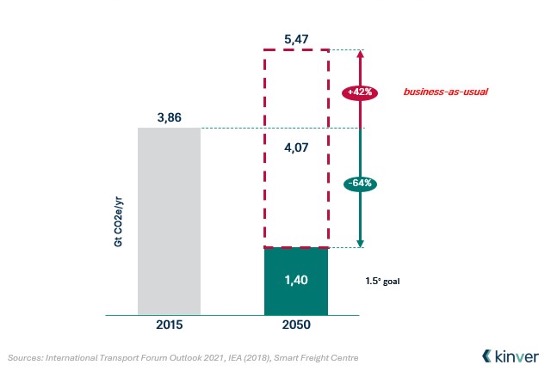
While share of emissions by mode of transport varies by region, road freight with its global relative share of 65 % by far contributes the most. Following suit is sea freight (21%), air freight (5%), railway freight (5%), and inland waterways (4%) respectively. In 2050, share of emissions from road freight is only expected to grow as economic growth and trade in developing regions will be heavily reliant on road infrastructure to move cargo.

Emissions from logistics play a crucial role in achieving global climate targets. For this reason, supply chain stakeholders need to actively collaborate to reduce emissions across all economic activities. A key input component for this effort will come from data-driven analysis and the identification of operational improvements, which rely on accurate GHG emissions accounting and reporting. However, current GHG emissions accounting for transport services varies significantly between companies.
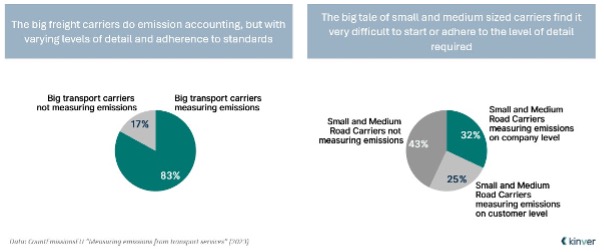
Despite the development of several calculation standards in recent years, the widespread adoption of a unified global standard has been lacking. No regulations have been established to drive this necessary standardisation. As a result, current practices for calculating and reporting GHG emissions from transport services have not yet reached the level of maturity required for transparency and comparability on GHG performance of logistics operations.
To address this gap, a new regulatory initiative from the EU named “CountEmissionsEU” sets out to standardise the GHG emissions accounting and reporting practises in the transport sector. Targeting all transport services starting or ending in the EU, CountEmissionsEU aims to establish a unified, standardised framework for calculating and reporting emissions across the EU. The standard of choice for this regulation is the ISO14083 (2023), which provides a global standard for quantifying greenhouse gas emissions from logistics operations.
The ISO14083 standard (ISO1083:2023 Greenhouse gases — Quantification and reporting of greenhouse gas emissions arising from transport chain operations) is designed to bring consistency, transparency, and comparability to emission calculations and reporting, facilitating more informed decision-making and encouraging widespread adoption of best practices.
_____________________________________________________________________________________________________________________
What the New Regulations Mean for Businesses in the EU and Norway
As the European Union advances its sustainability agenda, the introduction of the CountEmissionsEU initiative marks a pivotal moment for organisations across the continent. This new regulation is set to reshape how medium to large-sized companies—particularly those in manufacturing, wholesaling, and retailing—approach and manage their transport-related greenhouse gas (GHG) emissions. For businesses in the EU and Norway, the implications of this legislation will be profound, influencing everything from operational strategies to long-term sustainability goals.
A New Benchmark for Transparency and Accountability
At its core, CountEmissionsEU sets out to create a consistent, transparent framework for calculating and reporting GHG emissions tied to transport. This regulation aligns with the ISO 14083:2023 standard, which has already earned recognition as the latest global standard for assessing emissions from transport activities. For businesses in the EU and Norway, this means that all transport-related emissions, whether domestic or international, will need to be meticulously documented and reported.
One of the perhaps most important things to note about the CountEmissionsEU regulatory implementation of ISO14083:2023 is the
strict requirements on primary input data.
As specified in the CountEmissionsEU legislative proposal for a regulation, which the European Parliament adopted on the 1st reading vote in April 2024, the regulation applies to:
- “All entities providing or organising freight and passenger transport services in the Union that calculate emissions of a transport service starting or ending on the Union territory, and disclose disaggregated information on the emissions to any third party,” or
- “Data intermediaries that calculate information on greenhouse gas emissions of transport services and not only disclose information on those emissions provided by a concerned entity or other relevant legal or natural person.”
The use of primary and secondary data is specified as part of the legislative proposal, noticeably requiring the following:
- “Entities should use primary data to calculate the greenhouse gas emissions of a transport service which they provide, except for services provided by SME’s*.
- SMEs should prioritise the use of primary data for calculating greenhouse gas emissions of a transport service. When SMEs operate as transport subcontractors, they should be able to rely on secondary data, even if the transport organiser is using primary data for calculating the greenhouse gas emissions deriving from a transport service performed by other transport subcontractors or its own fleet.”
*EU Definition of a SME: Below 250 people and EUR 50 million.
For larger carriers with complex logistics chains, the new requirements can seem daunting. The regulation will mandate the use of primary input data, requiring detailed information directly from business operations, such as fuel consumption, actual vehicle distances travelled, load factors and empty running percentages. This contrasts sharply with earlier practices, which often relied on high-level rough estimates or default emission factors.
This development will impact all downstream reporting of emissions in supply chains. Shippers of goods will require their carriers to comply with the calculation and reporting standard to facilitate themselves staying compliant towards the next chain of reporting. Their customer-filtered version of emissions reporting will also need to be in line with the new standard. Collecting all these detailed emissions data from multiple carriers and reporting to a long list of customers in accordance with the reporting requirements of the ISO14083 is no small feat if supporting systems and data exchange infrastructure is not put in place. Downstream in supply chains, companies then need to collect all these emissions data, connect it with internal reference data (customer master data and order data), to finally report further down the supply chain to their respective customers again. Cost and efforts to comply with these regulatory developments will be noticeable.
Up until now, shippers have to some extent been able to calculate emissions from transport activity based on shipment statistics they retrieve from their respective carrier portfolio, or using data intermediaries that calculate for them. This has been useful for many, as their customers expectation on emissions reporting has exceeded their carrier’s ability to calculate and report emissions on a sufficiently granular level. However, with these new requirements, primary input data is out of reach for shippers, often located in carriers own operational transport management support systems (e.g., TA/TMS, rFMS fleet management/telematics, fuel card software databases). This will put forward higher expectations towards the carriers, both to include operational data as part of their shipments statistics and to calculate and report according to the standard.
For carriers or shippers that report emissions, the bar for reporting is also moving up quite substantially. Reporting requirements of the ISO14083 clearly defines not only the output format of the report, but also what supporting information that needs to accompany a report and how that supporting information includes a link to the raw data that underpins the output in the report, enabling auditing and transparency for every potential stakeholder of the report.
Understanding Primary and Secondary Data According to ISO 14083
In accordance with the upcoming regulations, the logistics industry is evolving towards more accurate and data-driven emissions calculations. This transition involves moving from simple statistical conversion factors to detailed modeling and primary data analysis. According to ISO 14083:2023, input data quality must distinguish between primary and secondary data for accurately calculating and reporting transport-related greenhouse gas (GHG) emissions.
- Primary data includes directly measured information, such as fuel consumption, precise distances travelled, and the actual weight of shipped goods. Sources for these input data are typically stored in carrier-specific support systems like telematics databases, fuel management systems, TA/TMS systems and enterprise resource planning (ERP) platforms.
- Modelled data is used when primary data is incomplete. As a form of secondary data, it has lower accuracy due to the variations in parameters and algorithms used. Modeled data considers emission-related transport parameters to model fuel use and emissions if primary data is not fully available. There are two modelling approached: (1) bottom-up energy-based, and (2) top-down activity-based.
- Default data is the alternative form of secondary data. Default data utilizes default GHG emission intensities based on a static set of assumptions. This includes industry and region averages based on assumptions of standard vehicle efficiency, load factor, and empty running. This approach aims to provide a representative snapshot for a specific transport operating category (TOC) based on a single, broadly representative combination of parameters, when primary or modelled data is not available or unapplicable.
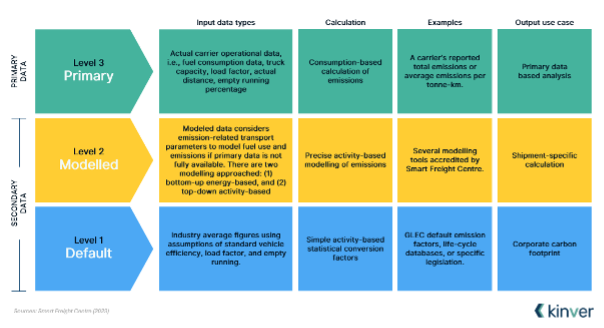
Effective GHG emissions calculations require these data points to be integrated, combining transport activity data (ton-kilometre, or tkm) with energy intensity measures to ensure accurate results. Additionally, all these historical activity-based data should include shipper references to shippers’ end-customers, ensuring that all emissions are traceable to shipments for downstream supply chain reporting purposes.
Establishing confidence in SC reporting with Input Data Quality Ranking
A key feature of ISO 14083:2023 is the emphasis on the quality of input data, using the indicators of “primary, modelled and default.” To further quantify the level of confidence stakeholders can have in the input data sources used in a certain calculation, Smart Freight Centre, with its guidance for End-to-End GHG Reporting of Logistics Operations, put forward an adapted “Data Quality Index” at the World Economic Forum in Davos (SFC, 2023). The approach introduces a weighted scoring system to evaluate the reliability and accuracy of the data used in emissions calculations.

“Information on data quality is as crucial as the emissions information, as it fosters trust in the shared information and enables transparency on any assumptions made in the calculation process (SFC, 2023)”
Such a weighted data quality ranking can help to further establish confidence in supply chain data, directly impacting the accuracy of GHG emission calculations. These rankings not only incentivize stakeholders to enhance data precision but also enable effective analysis, optimization and performance benchmarking across companies, sectors and industry.
Table 2.1: Data Quality Indicator at a TOC level (E2E Guidance, SFC, 2023)

Table 2.2: Data Quality Indicator at a TCE level (E2E Guidance, SFC, 2023)
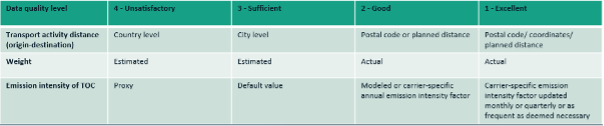
Definitions in accordance with GLEC and ISO14083:
Transport operation category (TOC): Group of transport operations that share similar characteristics, based on mode, journey, freight, trade lane, or contract type. Aggregation to a TOC can be based on a specific round trip, vehicle class, or schedule. E.g., maritime container transport or shared long-haul road freight of pallets.
Transport-chain element (TCE): Section of a transport chain within which the freight is carried by a single vehicle or transits through a single hub. E.g., the journey from port A to port B or the processing in a distribution center are TCEs.
Reporting Requirements: Data Management in Compliance with ISO14083
The ISO 14083:2023 standard enforces strict requirements for reporting GHG emissions, ensuring accuracy, traceability, and transparency. Reports must be formatted in a way that is consistent, traceable, and auditable. The reporting requirements can be classified into three categories:
- Output Metrics: ISO14083 specifies the following key output metrics to be included as a minimum in every emissions report, regardless of the scope and omissions. These key metrics has been standardized to help evaluate the GHG emissions performance of a logistics chain or activity. It also regulates the output format to secure normalisation.
- Emissions, expressed in well-to-wheel (WTW) CO2e (kg)
- Emission intensity, expressed as the emissions per activity (kgCO2e/t-km)
- Transport activity (t-km)
- Supporting Information: With the supporting information, the aim is to provide transparency and a clear understanding to all stakeholders reviewing the report. The following must be clearly documented and attached to each report:
- Report Scope
- Exclusions
- Implications of Exclusions
- Data sourcing
- Calculation Method
- Traceability: Companies must maintain clear records from collection to final reporting, ensuring all processes and raw data tables are accessible for detailed review and potential audits. The emission report must provide a link to where the underlying data forming the basis for the calculation can be found
- Source data table
To comply with these requirements without experiencing a tidal wave of manual efforts needed, companies must implement robust data management practices, ensuring that all relevant information—from initial data collection to final report generation—is accurately recorded and easily accessible for auditing purposes. Specification of the supporting information required with each report will also raise compliance cost and effort if not sufficiently automated with supporting systems. By adhering to these guidelines, carriers and shippers can not only ensure compliance with the standard, but also enhance their credibility and transparency in the eyes of stakeholders.
Inclusion of Logistical Hubs in ISO 14083:2023
ISO 14083:2023 has expanded the scope of transport-related greenhouse gas (GHG) emissions calculations to include emissions from logistical hub operations.
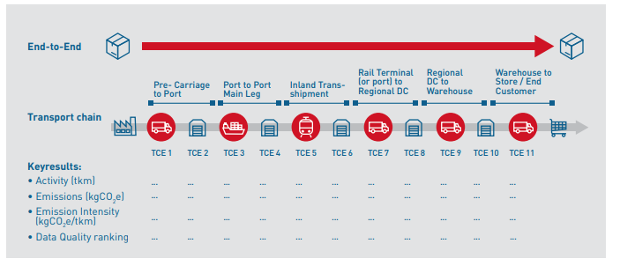
This marks a critical shift, as logistical hubs—warehouses, shipping container terminals, distribution centres, and cross-docking facilities—have traditionally been excluded from transport chain emission calculations. Consequently, many companies have benchmarked their emissions against a baseline year that overlooked these hubs. With the new standard’s inclusion of these facilities, organizations will likely see an apparent rise in their reported emissions. This change underscores the need to reassess baseline comparisons and refine sustainability analytics. Accurate, comprehensive emissions tracking is now more crucial than ever for companies aiming to achieve their long-term sustainability goals.
Regulatory Expansion to Lifecycle Emissions
Currently, the scope of GHG emission calculations under the CountEmissionsEU framework focuses on a well-to-wheel, operational perspective, primarily considering emissions generated directly from fuel and energy used during transportation and hub operations. However, the legislative proposal which was passed in April 2024 also states that within two years of the initial law's passage, the CountEmissionEU commission will need to bring forward their next iteration of the regulation to include lifecycle emissions, covering the entire environmental impact from production to end-of-life. This expansion will account for emissions associated with the entire lifecycle of transport vehicles, ships, trains, or aircraft, including their manufacturing, maintenance, and disposal.
This change will significantly alter the emissions profile for electric vehicles (EVs), which currently benefit from low operational emissions. Under the expanded lifecycle assessment, the environmental impact of battery production, vehicle manufacturing, and end-of-life disposal will be included, potentially increasing the calculated emissions for EVs. This holistic approach aims to provide a more accurate representation of the true environmental cost of transport, pushing companies to adopt more sustainable practices not just in their operations but throughout the entire lifecycle of their transport assets.
The Impact on Supply Chain and Logistics Operations
One of the most significant challenges posed by CountEmissionsEU is the increased compliance burden. Carriers will need to invest in new systems and processes to accurately capture and report their transport emissions. This includes potentially costly upgrades to data collection infrastructure and the implementation of rigorous reporting protocols.
For businesses operating across multiple EU countries, the harmonization of reporting standards will offer some relief, but the initial transition will require substantial effort. For shippers and supply chain stakeholders in general, (1) collecting all the data on a sufficiently disaggregated level, (2) merging and enriching the data with business references, before (3) filtering for each customer and (4) sending it out with (5) all supporting information as well as (6) link to where the underlying data can be found for assurance purposes is no minor task. Especially when you consider the various reporting requirements customers can have with regards to level of detail, frequency of reporting and not at least, keeping control of any customer’s customer references shared with you for later reporting purposes.
Moreover, the legislation places a spotlight on the environmental performance of logistics operations. Companies will need to consider the carbon footprint of their transport choices more carefully. This could lead to a shift towards more sustainable logistics practices, such as optimizing delivery routes, investing in electric vehicles, or choosing lower-emission modes of transport like rail or sea freight, as well as considering moving manufacturing closer to home market.
Compliance with ISO14083 calculation and reporting requirements will quickly become part of procurement processes and actors without sufficiently mature solutions will potentially lose out on business. It will be much easier for procurement officers to compare potential suppliers in RFQ-processes and existing suppliers in revisions of purchase contracts.
Managing the Complexity of Subcontracting
For many large companies, subcontracting is a common practice, particularly in the transport sector. However, the CountEmissionsEU initiative introduces complexities in how emissions from subcontracted services are reported. While the legislation allows for the use of secondary data by smaller subcontractors, large companies will still need to ensure that this data is accurate and aligns with the overall reporting framework. This adds another layer of complexity to supply chain management, as companies will need to closely monitor and possibly assist their subcontractors in meeting the new input data requirements based on the main carrier requirement.
Impacts of Additional Transport Legislation
Beyond CountEmissionsEU, other legislative developments are also further influence operational costs and compliance for suppliers of transport services. The EU's Mobility Package and the recent amendments in tolling regulations, such as mandatory CO2-based tolling for trucks, are increasing operational costs for carriers. Adding to this, the complexity of EU Digital Product Passport initiatives will be crucial to follow for anyone providing transport services or shipping goods in the EU territory.
These measures, combined with declining freight rates due to a weak economy, are putting additional pressure on transport logistics companies, especially for those managing extensive fleets or engaging heavily in road transport. These challenges emphasize the need for strategic adjustments and potential investments in zero-emission vehicles (ZEVs) as the EU pushes towards more stringent environmental standards by 2026 and beyond. However, with the limited capital available in the prevailing macroeconomic conditions, the large-scale investments in ZEV’s will likely be pushed back as carriers scramble to cut costs short-term.
Turning Compliance into Opportunity
While the CountEmissionsEU regulation presents clear challenges, it also offers forward-thinking companies an opportunity to lead in sustainability. By embracing the new standards, businesses can enhance their environmental credentials, which is increasingly important to consumers, investors, and partners. Companies that successfully integrate these requirements into their operations can gain a competitive edge, positioning themselves as leaders in the transition to a low-carbon economy.
In Norway, where sustainability is already a key focus for many businesses, the alignment with EU standards reinforces the importance of continuing to innovate in this area. Companies like Ekornes, Ahlsell and Saint-Gobain Distribution Norway have already shown a commitment to sustainability, and the CountEmissionsEU framework provides a clear path forward for others to follow.
Conclusion
The CountEmissionsEU initiative is more than just a regulatory hurdle; it is a call to action for companies across the EU and Norway to rethink their approach to transport emissions. By proactively addressing the challenges and seizing the opportunities presented by this legislation, medium to large-sized businesses can not only ensure compliance but also drive meaningful progress toward a more sustainable future.
As the European market continues to evolve, those companies that adapt quickly and efficiently to these new requirements will be well-positioned to thrive in the increasingly sustainability-focused business environment.
References:
- Jaramillo, P., Kahn Ribeiro, S., Newman, P., Dhar, S., Diemuodeke, O.E., Kajino, T., Lee, D.S., Nugroho, S.B., Ou, X., Hammer Strømman, A., Whitehead, J., 2022, 'Transport', in IPCC, Climate Change 2022: Mitigation of Climate Change. Contribution of Working Group III to the Sixth Assessment Report of the Intergovernmental Panel on Climate Change, Cambridge University Press, Cambridge, UK and New York, NY, USA. DOI: 10.1017/9781009157926.012.
- ISO 14083 2023, Greenhouse gases — Quantification and reporting of greenhouse gas emissions arising from transport chain operations.
- Smart Freight Centre,2023, End-to-End GHG Reporting of Logistics Operations Guidance.
- European Union, 'Official SME definition', available at: https://eur-lex.europa.eu/EN/legal-content/summary/micro-small-and-medium-sized-enterprises-definition-and-scope.html (Accessed: September 2024).
- Smart Freight Centre 2023, Data exchange of GHG Logistics Emissions.
- European Parliament 2023, EU Legislation in Progress: CountEmissionsEU - European Parliament Briefing, October. https://epthinktank.eu/2023/12/13/countemissionseu-measuring-emissions-from-transport-services-eu-legislation-in-progress/
- European Parliament 2024, CountEmissionsEU, Summary from Voting on First Reading, March.
- European Parliament Press Release 2024, CountEmissionsEU, New GHG Reporting Standards, 1 March.
- European Commission, 'EU's Mobility Package', available at: https://transport.ec.europa.eu/transport-modes/road/mobility-package-i_en (Accessed: September 2024).
- Transpoco, ‘EU Mobility Package', available at: https://www.transpoco.com/blog/what-is-the-eu-mobility-package (Accessed: September 2024).
- Directive (EU) 2022/362, 'EU truck tolls to vary by CO2 emissions of vehicle', available at: https://www.transportenvironment.org/uploads/files/202403_TE_Eurovignette_briefing_update.pdf (Accessed: September 2024).
- European Commission 2023, Amendment of Directive, available at: https://eur-lex.europa.eu/legal-content/EN/TXT/HTML/?uri=CELEX:52023PC0189 (Accessed: September 2024).
- Transport & Environment 2024, Progress briefing on legislation, available at: https://www.transportenvironment.org/uploads/files/202403_TE_Eurovignette_briefing_update.pdf (Accessed: September 2024).
- World Business Council for Sustainable Development, 'EU Digital product passport', available at: https://www.wbcsd.org/resources/the-eu-digital-product-passport/ (Accessed: September 2024).
- European Parliament 2024, 'EU Digital product passport for the textile sector', available at: https://www.europarl.europa.eu/thinktank/en/document/EPRS_STU(2024)757808 (Accessed: September 2024).
- Saint-Gobain Distribution Norway 2024, https://www.kinver.io/references/saint-gobain-distribution-norway-sustainability-interview, Sustainability Interview, Kinver.io Article, accessed August 2024.
- Ekornes 2024,, Kinver.io Article, accessed August 2024.
